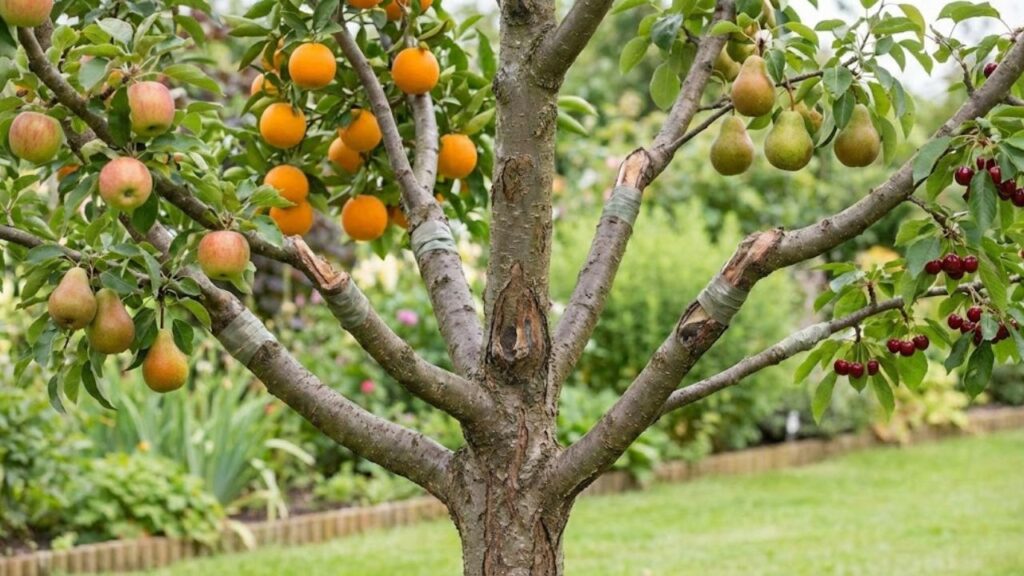
On a cool spring evening when the light glows like warm honey and the soil still holds warmth from the day you walk out to check on what appears to be an ordinary young fruit tree. The trunk is no thicker than your wrist with smooth greenish-brown bark and branches reaching upward with youthful energy. But as you step closer your eyes catch something unusual. On one branch tight clusters of peach blossoms have just begun to open with soft pale petals. Another limb carries glossy darker buds that will become plums. A third branch shows tiny serrated leaves in a completely different shade. One trunk grows many different fruits. This living contradiction is called a fruit salad tree.
The Dream of Variety on One Trunk
Everyone who has walked through a fruit market in late summer knows that small ache of wanting everything. The peaches are sun-warmed and dripping. The tart cherries are almost black with ripeness. The apples show streaks of crimson and gold. The idea that you might walk into your backyard and gather all of that from a single tree sounds like something out of a children’s book or a botanical fairy tale. Yet the innovation that makes this possible is not magic. It is multi-grafting. This is a deceptively simple and intensely human craft that has been quietly reshaping gardens for centuries. Grafting is an old story about humans persuading plants to share a life. A rootstock is chosen for its vigor or disease resistance. It is joined to a scion. A scion is a small piece of branch from another tree that carries the genetic code for the fruit you want. Done right the wound closes and tissues knit together. Sap begins to flow between two plants that were once strangers. Multi-grafting simply asks what if we didn’t stop at one scion. What if we treated a single trunk like an apartment building with several varieties sharing the same address. The early attempts were practical more than poetic.

What Exactly Is a Fruit Salad Tree?
Despite its playful name a fruit salad tree is not some genetically engineered chimera. It is instead a careful collage. On one compatible rootstock like a sturdy peach root or a hardy apple foundation you graft multiple varieties that all belong to the same fruit family. So you might have five types of apples with each one ripening at a different time. Or you could have a stone fruit tree with peaches and plums & nectarines & apricots all threaded into the same living architecture. Walk around such a tree in midsummer and you might feel as if you are circling through seasons. One branch heavy with almost-ripe peaches smells like sunshine and syrup. Another branch just beginning to swell its green plums carries a quieter promise. Later in the year an upper limb might still be holding crisp apples while lower branches have long since surrendered their fruit. The multi-graft tree is not only about abundance. It is about staggering time and stretching the harvest like a long slow song.

The Quiet Science Beneath the Bark
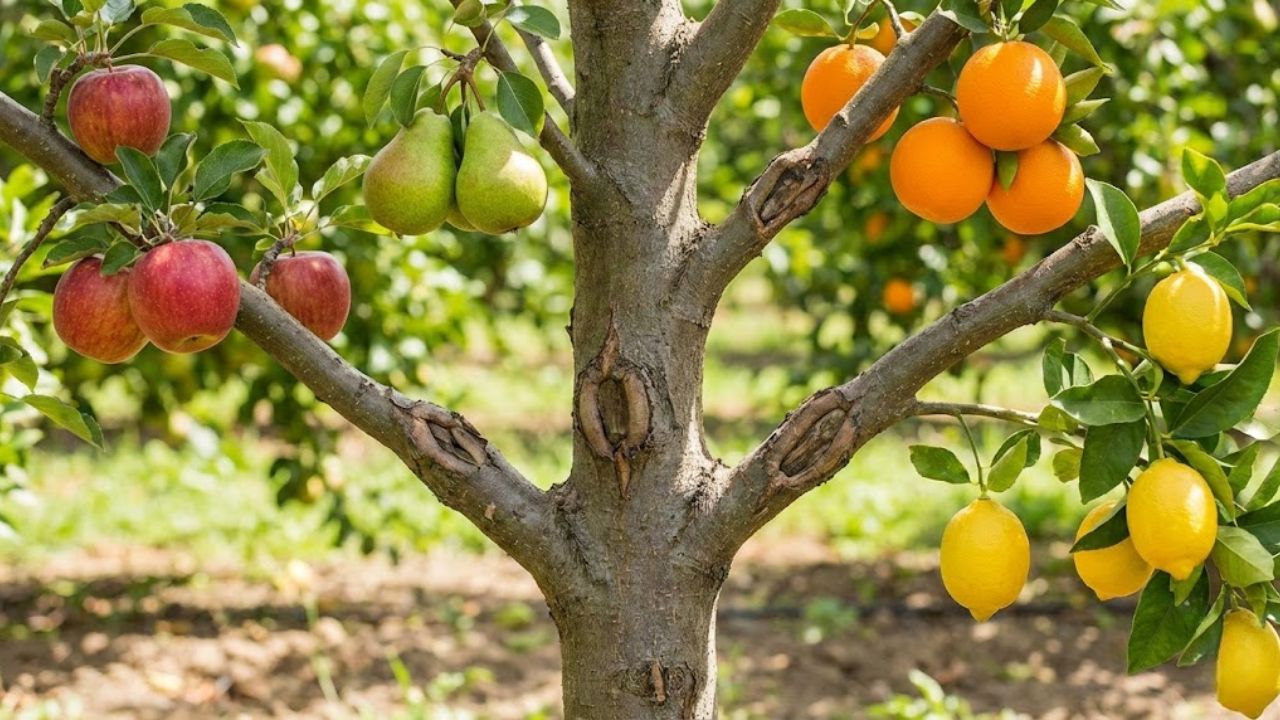
Inside that narrow trunk biology does elegant work. The rootstock pushes water and nutrients upward without caring whether the branch above will bear a plum or a nectarine. The scions are those grafted branches and each keeps its own genetic identity. One might bloom earlier & another later. One may favor tangy fruits with thick skins while another produces sweet thin-skinned delicacies that bruise easily. Multi-grafting succeeds only when the rootstock and scions are compatible. Generally this means staying within the same species or very close relatives like apples with apples or peaches with nectarines and some plums or citrus with citrus. When the match is right the graft union heals into a narrow seam of scar tissue that over the years can become almost invisible. What you are left with is a single tree whose branches tell different stories but whose roots share the same language of water & minerals and mycorrhizal whispers underground.
Designing Your Own Edible Mosaic
Creating a fruit salad tree starts long before you make any cuts. It begins with thinking about the harvest you want and the work you are willing to do. Stand in your yard or on your balcony and observe. How much sun does this space get? How does the wind move through during different seasons? Where does water collect after it rains? A multi-graft tree is not just something unusual. It is a serious investment & the location you pick will determine how well it grows. Next you need to think about flavor and timing. Do you want all your fruit at once for a brief abundant harvest or do you want fruit spread out over several months? You might choose early season apples along with mid-season and late-season varieties for one tree so you can pick fruit from midsummer through fall. Or you might want a stone fruit tree that produces everything at once during an intense two-week period of peaches & plums and nectarines that forces you to spend time slicing and drying and making jam and giving fruit away. You also need to think about how different varieties grow. Different types grow at different rates. Some produce vigorous shoots that grow quickly and aggressively. Others grow more slowly. On a multi-graft tree one aggressive branch can easily dominate and block light from reaching other branches. So you should choose varieties that grow at similar rates or be prepared to prune regularly to keep the tree balanced.
Grafting as Slow, Careful Art
Living with a Tree that Refuses to Be Just One Thing
Once the grafts have taken the real relationship begins. A fruit salad tree needs more attention than a single-variety tree would. You walk around it slowly & notice how one branch has grown faster while another stays behind. Your pruning shears become a tool for balance. You trim one area and cut back another to keep the canopy even so no single graft takes over. There is a quiet closeness to this kind of care. In early spring you might stand beneath different blossoms. White apple flowers appear on one side and pinkish ones on another with deeper colors from a crabapple graft at the top for pollination. Bees ignore your labels and move among the flowers following their own pattern while spreading pollen that will affect the harvest. By midseason the tree tells you stories through its fruit. That unusual variety you added two winters ago has finally produced fruit and you bite into it right there in the yard. Juice covers your fingers and you close your eyes in surprise. How did something this crisp & aromatic come from the same trunk as that soft perfumed peach you ate last week? The answer is that it did and it didn’t. One root supports many identities.

A Compact Answer to Big-Space Dreams
For many modern gardeners space is no longer a gentle sprawl of land but a tightly negotiated privilege. Balconies and small courtyards and narrow side yards pressed between fences and walls are the new orchards. The multi-graft tree feels like an almost rebellious reply to this reality. If you can grow only one fruit tree why should you settle for one flavor & one season and one story? Even in larger gardens multi-grafting can be a strategy instead of a novelty. You might have heavy clay soil in one area and sand in another or a shallow strip above bedrock. Instead of scattered struggling trees you can plant one carefully chosen rootstock in the best spot and then layer your hopes onto it with varieties that resist local diseases & that shrug off your region’s cold snaps or heat waves & that ripen at times when you are actually home to harvest them. From a resilience perspective it is quietly radical because you get one tree that is diversified. If a late frost ruins early blossoms on one branch a later-blooming graft may still deliver. If a worm or disease favors a particular variety the others might be spared. Of course a single trunk is still a single point of failure. But within that limitation the multi-graft design spreads risk in subtle and thoughtful ways.
The Sensory Symphony of Harvest
When harvest season arrives a fruit salad tree becomes a living pantry. Early in the morning when dew still clings to leaves you bring a small basket & walk around your tree. You pick a handful of bright lime-green plums that are still a bit firm. You grab a pair of freckled apples that come off with a gentle twist. Higher up the darker fruits are still firm and not fully colored so you leave them for another week. The air around the tree changes through the season. In early summer it smells green and sharp like leaves and snapped stems. By late summer it becomes thick with the smell of overripe fruit that has fallen & split. Sugar seeps into the soil where ants and beetles gather. The tree hums with insects and with possibility. A bowl of mixed fruit on your table tells the story of a single trunk that refused to choose just one way to be. There are practical benefits as well. You learn over time how different varieties work in your kitchen. One branch offers apples that hold their shape in pies. Another gives soft fragrant fruit that collapses into sauce. A particular plum graft turns out to be perfect for drying into chewy tart-sweet slices. Each year as you prune and taste & adjust you are not just tending a tree but editing a living recipe.
Balancing Beauty, Labor, and Longevity
Multi-graft trees need regular care. Having multiple varieties means you must pay attention. You need to understand when each grafted branch blooms and how fast it grows. You should remember which branch produces too much fruit and requires thinning and which one grows slowly and needs protection from shade. The tree requires ongoing involvement instead of just planting it once & walking away. However the benefits are worth it. A properly pruned multi-graft tree can become a beautiful focal point in a small yard. Its different leaf shapes and fruit colors make it interesting throughout all four seasons. During winter you can observe its history through its structure. The older graft unions appear thick and sturdy while the newer ones look thin and fragile. A child might touch those scars and wonder why the bark looks different in various spots. You can then explain that some stories are deliberately created by joining different parts together.
A Quick Reference for Planning Your Fruit Salad Tree
| Fruit Family | Possible Varieties on One Tree | Key Considerations |
|---|---|---|
| Apples | Early, mid, late-season apples; dessert, cider, and cooking types | Match rootstock vigor; ensure overlapping bloom for pollination |
| Stone Fruits | Peach, nectarine, plum, apricot (depending on compatibility) | Watch for differing growth rates; protect from late frosts |
| Citrus | Lemon, lime, orange, mandarin, sometimes grapefruit | Needs warmth and sun; some varieties more cold-sensitive |
| Pears | European and some Asian pear varieties | Choose compatible rootstock; manage upright, vigorous growth |
| Cherries | Sweet and sour cherry types (on suitable rootstock) | Prone to birds; some varieties need cross-pollination |
Where Innovation Meets Intimacy
In a time of drones and data streams the term “innovative horticulture” usually brings to mind high-tech greenhouses and automated watering systems. But the multi-graft fruit tree represents a different type of innovation—one that is quiet and hands-on and depends more on human care than on technology. Each graft is created with a basic knife and each choice comes from patience and interest as much as from reference guides and climate maps. Standing under a mature fruit salad tree gives you a brief sense of being removed from the normal flow of time. You notice the grafts you created years earlier now in bloom & the ones you attached last winter just starting to produce their first tentative leaves. The roots beneath you have likely been growing stronger and reaching deeper for ten years or longer. Still the fruits you hold that are warmed by the sun last only as long as a single afternoon.